
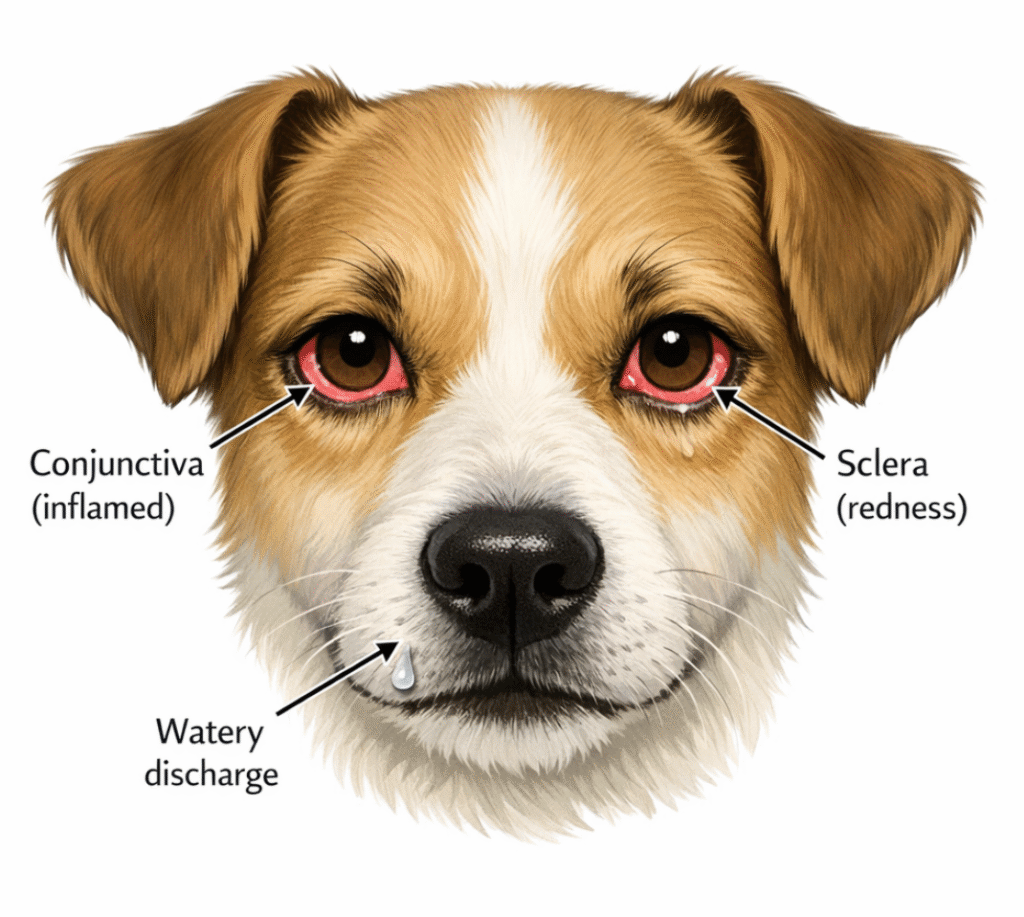
“Dog pink eyes” is a phrase I hear often in practice, and it’s usually referring to red, irritated-looking eyes—most commonly conjunctivitis (inflammation of the conjunctiva). Dog pink eyes can be mild and temporary, but they can also be an early sign of something more serious like a corneal ulcer, dry eye, glaucoma, or a foreign body. The tricky part is that many eye problems look similar at home, but the treatments are very different.
Below is a practical, vet-written guide to dog pink eyes that helps you recognize common causes, know what you can safely do at home, and understand when urgent care is needed.
What Are “Dog Pink Eyes,” Exactly?
In everyday terms, dog pink eyes usually means:
- The whites of the eye look red
- The inner eyelids look swollen or “puffy”
- There may be discharge or tearing
- Your dog might squint, blink a lot, or rub the face
Medically, dog pink eyes can involve:
- Conjunctivitis (most common)
- Keratitis (cornea inflammation)
- Uveitis (inflammation inside the eye)
- Glaucoma (high pressure)
- Dry eye (keratoconjunctivitis sicca, KCS)
Common Signs Owners Notice With Dog Pink Eyes
| Sign | What It May Mean | Why It Matters |
|---|---|---|
| Redness of whites or inner eyelids | Conjunctivitis, allergy, irritation | Common but not specific |
| Yellow/green discharge | Bacterial infection or secondary infection | Needs vet guidance; don’t self-medicate |
| Clear watery tears | Allergy, irritation, foreign body | Can progress if cause remains |
| Squinting or keeping eye closed | Pain (ulcer, foreign body, uveitis) | Urgent—painful eye conditions can worsen fast |
| Cloudy/blue haze on cornea | Ulcer, edema, glaucoma | Urgent—cornea issues need prompt care |
| Pawing at eye/face rubbing | Pain or itch | Can cause ulcer or worsen damage |
| One eye affected vs both | One eye suggests foreign body/ulcer; both suggests allergy/viral | Helps narrow likely causes |
If your dog has pink eyes plus squinting, treat it as time-sensitive.
Causes of Dog Pink Eyes (From Most Common to More Serious)
1) Allergies and Environmental Irritants
This is a very common reason for dog pink eyes, especially during seasonal changes.
Typical clues:
- Both eyes often affected
- Clear tearing
- Mild swelling
- Sneezing/itchy skin may also be present
2) Conjunctivitis (Infectious or Non-Infectious)
Conjunctivitis is inflammation of the conjunctiva. In dogs, “pink eye” can be:
- Secondary to allergies
- Due to eyelid anatomy (entropion/ectropion)
- Due to infection (bacterial, sometimes viral)
Important: Primary bacterial conjunctivitis is less common than people think; many cases are secondary to another problem (dry eye, allergy, irritation).
3) Dry Eye (KCS)
Dry eye is a major, frequently missed cause of recurring dog pink eyes.
Clues:
- Thick, stringy mucus discharge
- Dull corneal surface
- Chronic redness
- Recurrent “conjunctivitis” that keeps coming back
Dry eye needs veterinary testing and long-term management to prevent corneal damage.
4) Foreign Body (Grass Seed, Dust, Hair)
A foreign body under the eyelid can cause sudden dog pink eyes.
Clues:
- Often one eye
- Sudden onset
- Excessive tearing
- Squinting
5) Corneal Ulcer (Scratch on the Eye)
Corneal ulcers can look like simple dog pink eyes at first—but they’re very different and can worsen rapidly.
Clues:
- Squinting, pain, light sensitivity
- Cloudy/blue cornea
- Your dog resists you touching the face
Warning: Some medications (especially steroid eye drops) can make ulcers dramatically worse.
6) Eyelid or Eyelash Problems (Entropion, Distichia)
When lashes or eyelids rub the cornea, dog pink eyes can become chronic.
Clues:
- Recurrent redness and tearing
- Squinting that improves then returns
- More common in certain breeds (e.g., Shar-Pei, Bulldogs, Cocker Spaniels)
7) Glaucoma or Uveitis (True Emergencies)
These are less common but extremely important because they can lead to vision loss.
Clues suggesting emergency:
- Severe pain, sudden squinting
- Eye looks enlarged or very firm
- Cloudiness, fixed/dilated pupil
- Sudden vision changes (bumping into things)
If you suspect this, don’t wait.
What You Can Safely Do at Home (Short-Term)
If your dog’s pink eyes are mild and your dog is comfortable (no squinting, no cloudiness, no pawing), you can do supportive care for 12–24 hours while you arrange a vet visit if needed.
Safe home steps for dog pink eyes:
- Rinse with sterile saline eyewash (plain, no medication) to flush dust/pollen.
- Use a warm compress for 2–3 minutes to soften crust (don’t press on the eye).
- Prevent rubbing (E-collar if your dog is pawing).
- Avoid smoke, perfumes, dusty rooms, and grooming sprays near the face.
Do NOT do these at home:
| Don’t | Why |
|---|---|
| Don’t use human “pink eye” drops | Many are inappropriate for dogs; can delay proper care |
| Don’t use leftover prescription drops | Wrong medication can worsen ulcers or infections |
| Don’t use steroid eye drops without testing | Steroids can worsen corneal ulcers and infections |
| Don’t wait days if there’s squinting | Pain usually means corneal involvement or deeper eye disease |
When Dog Pink Eyes Need a Vet (and How Soon)
Go to a vet the same day if you see:
- Squinting or obvious pain
- Corneal cloudiness/blue haze
- A whitish spot on the cornea
- Eye held shut
- Significant swelling
- Thick yellow/green discharge
- Your dog seems unwell (fever, lethargy)
- Eye injury or trauma (even mild)
Go immediately / emergency if:
- Eye looks suddenly enlarged or bulging
- Sudden blindness or disorientation
- Severe pain + dilated pupil (possible glaucoma)
- Blood in the eye or severe trauma
With dog pink eyes, early evaluation can prevent ulcers from deepening and protect vision.
What Your Veterinarian Will Do (Typical Eye Workup)
A good eye exam for dog pink eyes often includes:
| Test/Step | What It Checks | Why It’s Important |
|---|---|---|
| Fluorescein stain | Corneal ulcers/scratches | Guides safe medication choice |
| Schirmer tear test | Dry eye (KCS) | Identifies a common chronic cause |
| Tonometry | Eye pressure | Screens for glaucoma/uveitis |
| Eyelid eversion | Foreign material under lid | Finds hidden irritants |
| Cytology/culture (selected cases) | Infection type | Useful in recurrent or severe cases |
These tests are standard in modern small-animal practice and are widely recommended in veterinary ophthalmology references.
Treatment Options for Dog Pink Eyes (Based on Cause)
| Cause | Typical Vet Treatment | Notes |
|---|---|---|
| Allergy/irritation | Lubricants, anti-inflammatory meds (non-steroid if ulcer not ruled out), address allergens | Sometimes oral allergy meds are added |
| Bacterial conjunctivitis (often secondary) | Antibiotic eye drops/ointment | Vet will look for underlying trigger |
| Dry eye (KCS) | Tear stimulants (e.g., cyclosporine/tacrolimus) + lubricants | Usually long-term management |
| Corneal ulcer | Antibiotic drops + pain control, sometimes serum drops | No steroids; rechecks are important |
| Foreign body | Removal + meds | Often rapid improvement after removal |
| Eyelid/lash abnormalities | Medical relief + surgical correction if needed | Prevents repeat injury |
| Glaucoma/uveitis | Pressure-lowering or anti-inflammatory therapy ASAP | Emergency to protect vision |
Breeds More Prone to Dog Pink Eyes
Some dogs are predisposed because of eye shape, eyelid conformation, or tear film issues.
| Higher-Risk Group | Examples | Why |
|---|---|---|
| Flat-faced (brachycephalic) | Pug, Bulldog, Shih Tzu | Exposed eyes, shallow sockets, irritation |
| Dogs prone to dry eye | Cocker Spaniel, Westie | Tear film disorders |
| Dogs prone to eyelid issues | Shar-Pei, Chow Chow | Entropion causes rubbing |
Newer, Reliable Sources to Know (For Owners Who Want to Read More)
For dog pink eyes and canine eye disease, veterinarians commonly rely on:
- ACVO (American College of Veterinary Ophthalmologists) client education resources (updated regularly)
- Peer-reviewed veterinary ophthalmology literature (e.g., Veterinary Ophthalmology journal)
- Current editions of clinical references used in practice, such as Gelatt’s Veterinary Ophthalmology and evidence-based reviews on conjunctivitis, dry eye (KCS), and corneal ulcer management
If you want, tell me where you’re located and I can point you to ACVO-certified ophthalmology resources in your region.

Why is my dog having a diarrhea?